Most guides to picking a courier compare headline prices. For a marketplace seller that is the least useful thing to compare, because the expensive events in your shipping are not the postage — they are the refunds, the disputes, and the defects on your seller account.
Here is what actually decides whether a courier makes you money.
Proof of delivery is the whole game
On eBay, Etsy, Amazon and Vinted, an item-not-received claim is decided on evidence. If you cannot show delivery, you lose — and you lose the item as well as the money.
So judge a courier on the quality of its evidence:
- Tracking visible on the carrier's own site. A marketplace or a bank wants to verify delivery independently, not read your screenshot.
- A delivery photo. This is the difference between "the system says delivered" and an image of the parcel inside the buyer's porch. It resolves most honest disputes instantly, because the buyer usually finds the parcel.
- A timestamp and a location that matches the delivery address.
- Retention. Chargebacks can arrive months later. The evidence has to still exist when it does.
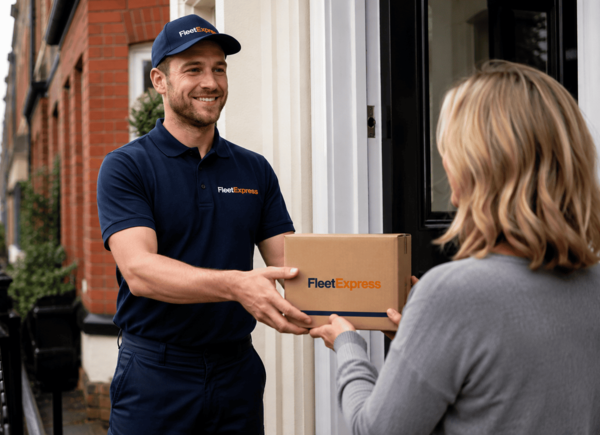
Every Fleet Express delivery is photographed as standard and the image sits on the tracking page alongside the timestamp — not behind a login, so you can send a buyer or a marketplace a link that speaks for itself.
Untracked postage is cheaper right up until your first claim, at which point it costs you the item, the postage, the refund and a defect. If an order is worth more than a couple of pounds, it needs tracking.
Protect your dispatch metrics
Late dispatch is one of the easiest ways to damage a marketplace account, and it is nearly always self-inflicted.
- Set handling time honestly. Quote what you can achieve on a bad week, not a good one. A one-day handling time you miss is worse than a two-day one you always beat.
- Know your cut-off. Ours is 5pm for next working day. A drop-off point's own cut-off will be earlier — treat that as your deadline.
- Mind Friday. "Next day" means next working day, so a Friday dispatch lands Monday. Say "next working day" in your listings or you will spend weekends answering messages. See our next day delivery guide.
- Upload tracking the day you dispatch. On most platforms the tracking upload, not the parcel, is what marks the order as dispatched on time.
Pricing postage without eroding margin
Free postage generally lifts conversion and helps you in marketplace search, but only if the real cost is inside your price. Work out your true cost per order:
Courier rate + VAT + box, tape and void fill + label + the amortised cost of replacements and refunds = actual shipping cost per order
Sellers routinely forget the last term. If one parcel in 200 goes missing on a £30 item, that is 15p per order before you have paid for a single box. Build it in, or your best-selling line quietly loses money.
Then match the service to the item rather than using one default:
| Order type | Sensible service | Why |
|---|---|---|
| Low value, not urgent | Economy from £3.99 + VAT | Same tracking and cover, lowest cost |
| Standard orders | 2-Day from £5.99 + VAT | Meets buyer expectations at sensible cost |
| Gifts, dated, high value | Next Day from £8.99 + VAT | Speed buyers will pay a premium for |
| Bulky but light | Compress and re-measure first | Volumetric weight decides the price |
Offering economy as free and next day as a paid upgrade lets the buyers who care about speed fund it, instead of every buyer paying for it.
Returns will happen — plan for them
Etsy and eBay both push returns policies hard, and clothing categories see high rates by default. A returns process that requires you to email a label on request is a support burden that scales badly.
A pre-paid returns label from £2.99 plus VAT, dropped off at any of 10,000+ locations, turns a return into something the buyer handles alone. It also gives you tracking on the inbound leg, which matters when a buyer claims they returned something and you have no record.
What matters less than sellers think
- A 20p price difference. One prevented dispute is worth more than a hundred parcels of saving.
- Brand recognition with buyers. Buyers care that it arrived, on time, with tracking that works.
- Same-day options you will never use. Buy for your actual order profile.
- Integrations you cannot operate. A simple flow you run correctly every day beats a sophisticated one you half-configure.
A checklist for judging any courier
- Is tracking granular enough to answer "where is my order?" without phoning anyone?
- Is there photo proof of delivery, and can a buyer see it without logging in?
- What insurance is included as standard, and what does a claim actually require? (£100 standard with us.)
- Can you reach a human being when a parcel goes wrong? (0800 079 3859, UK-based, Mon–Fri 8am–6pm.)
- What is the real cut-off at the drop-off point you will use?
- Are the surcharges for remote postcodes and oversize parcels transparent up front?
- Are returns easy enough that you would happily offer them?
When to move to a business account
Once you are shipping consistently every week, per-parcel booking becomes the expensive option. A Fleet Express business account gives you volume pricing, monthly invoicing instead of a card payment per parcel, one dashboard for every shipment, and a named account manager who knows your account when something needs chasing.
For more on the numbers, see how to cut shipping costs without losing customers.
Frequently asked questions
The questions marketplace sellers ask us most are below, with more on the FAQ page.
Try it on one week of orders
The honest test is your own parcels. Run a week of dispatches through the Fleet Express quote tool, compare the real cost against what you pay now, and see how the tracking and delivery photos look from your buyer's side. If you would rather talk it through first, get in touch — we will look at your volumes and tell you honestly whether an account is worth it yet.